"Let's Jump on a Call" - Why Async Communication is Powerful (If You Get It Right)
"Let's Jump on a Call" - Why Async Communication is Powerful (If You Get It Right)
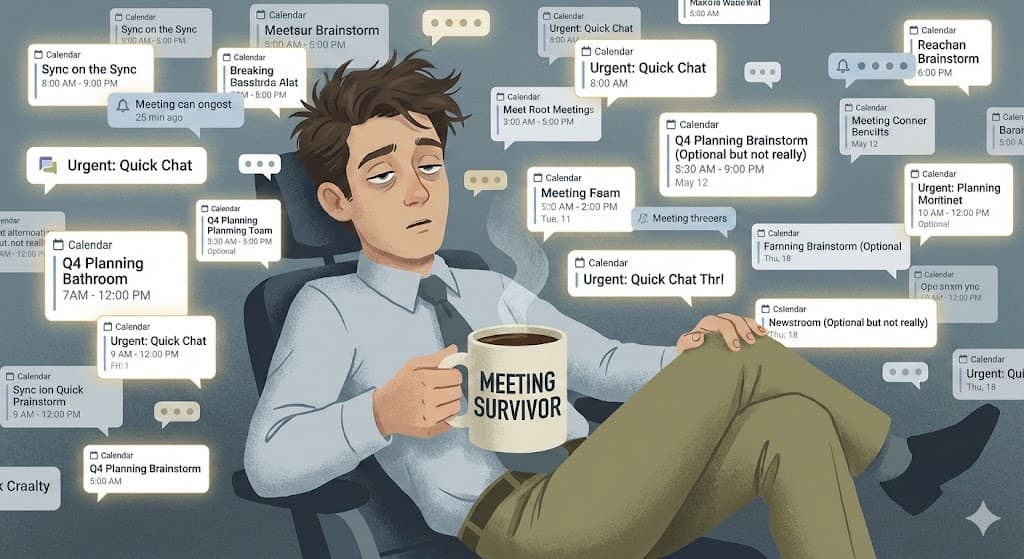 Meeting Survivor
I've seen organisations where back-to-back meetings are the norm. Nobody has time to breathe. People act like this is completely normal, everyone running around with their hair on fire, skipping lunch, too busy to think. The badge of honour is a completely packed calendar and the phrase "I'm slammed" has become a greeting.
The irony? We all know the meme. "This meeting could have been an email." And honestly? It's right more often than any of us want to admit.
The Meeting Epidemic
The numbers are frankly staggering.
According to Atlassian's 2024 research across 5,000 workers on four continents, meetings are ineffective at disseminating information, encouraging collaboration, and accomplishing tasks 72% of the time. That means three out of every four meetings you attend are, statistically speaking, a waste of your time.
78% of workers say they're expected to attend so many meetings, it's hard to get their work done. Let that sink in. The very thing designed to help us work together is actively preventing us from working at all.
Employees now spend an average of 11.3 hours per week in meetings, adding up to roughly 392 hours per person per year. That's nearly ten full working weeks spent sitting in meetings. And here's the kicker: only 37% of meetings use an agenda, and only 37% result in a decision.
So what are we actually doing in there?
 Sync vs Async Work
Why Meetings Are Broken
Let's be honest about what a meeting invite actually represents. When you send that calendar request, you're not just asking for 30 minutes of someone's time. You're demanding that they be available at a specific time, on a specific day, regardless of their priorities, their energy levels, or what they might be in the middle of.
You're effectively saying: "Your work? Park it. That problem you were just about to solve? It can wait. That creative flow you were in? Gone."
Virtual meetings have become the endless purgatory of post-pandemic work. We all know what's happening. 52% of attendees lose attention within the first 30 minutes. People are doing other work in the background. They're checking emails. They're on their phones. They're physically present but mentally somewhere else entirely.
And large meetings? They're particularly useless. 43% of workers say a few people tend to dominate meetings, making it hard for others to participate. So we've got a room full of people, most of whom aren't speaking, many of whom shouldn't even be there, all waiting for the handful of voices who always speak up to finish so everyone can get back to their actual jobs.
A little over half of workers leave meetings without a clear idea of what to do next, and 77% said meetings just result in follow-up meetings.
Meetings about meetings. We've created a self-perpetuating cycle of productive-looking unproductivity.
The Uncomfortable Truth About Flexibility
Here's where I want to get a bit pointed.
As a society, we love to talk about supporting working parents, carers, people with disabilities, and those with commitments outside of work. We put it in our company values. We mention it in job adverts. We include it in our diversity and inclusion statements.
Then we schedule a "quick sync" at 3pm on a Tuesday.
Do you know what happens at 3pm? School pickup. Medical appointments. Caring responsibilities. The things that make life actually work.
Traditional, synchronous work environments privilege some over others. If organisations rush back to this structure, they run the risk of leaving many people, and the valuable perspectives they bring, out of the workforce entirely.
82% of women want workplace flexibility, according to Future Forum research. And the struggle to find consistent, quality childcare means parents are more likely to leave their jobs than non-parents.
When we insist that everyone must be available for synchronous communication at arbitrary times, we're not being neutral. We're actively discriminating against anyone whose life doesn't fit the mythical "always available" worker template. That includes parents, carers, people managing health conditions, neurodivergent colleagues who might work better at different times, and anyone in a different time zone.
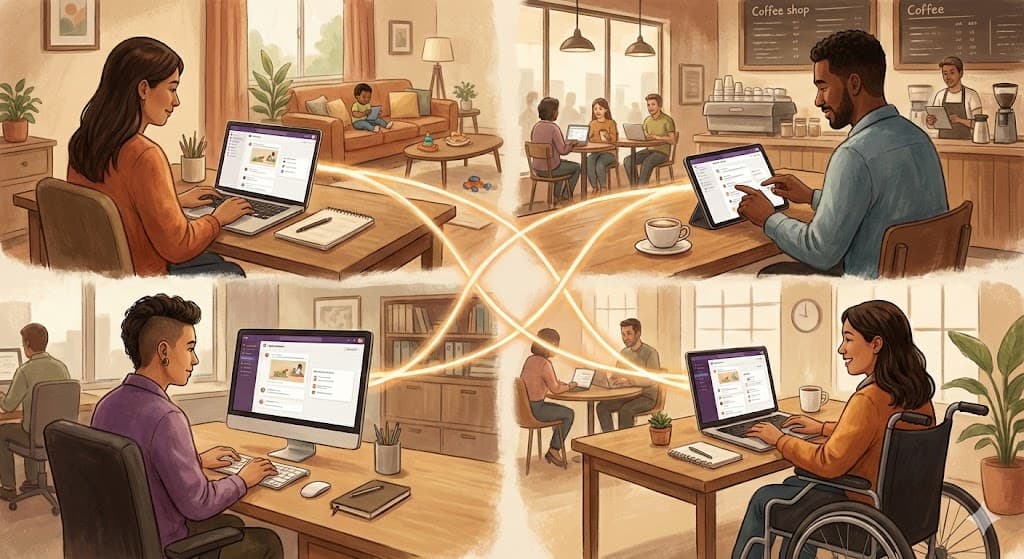 Diverse Async Team
The Power of Async
Here's the good news: there's a better way, and you're probably already using the tools.
Asynchronous communication, whether that's Slack, Teams, email, or documented collaboration in tools like Notion, allows your recipients to view your request, think about it properly, and respond at a time that suits them.
This isn't laziness. It's respect.
Asynchronous communication has been especially beneficial for working parents, neurodivergent employees, and distributed teams.
When done well, async communication also produces richer, more considered responses. You can include references. You can attach documents. You can share links to relevant resources. You can take the time to think before you respond rather than being put on the spot in front of a dozen colleagues.
Asynchronous culture allows employees to work when they are most focused and engaged, leading teams to feel more productive. People can prioritise work, avoid distractions, and allocate energy toward high-impact tasks during their peak performance hours.
For organisations that operate across multiple time zones, asynchronous communication eliminates the bias toward any single time zone, ensuring all team members have an equal opportunity to contribute.
How to Do Async Right
Right then. If you're convinced, here's how to actually make it work.
Do This
Front-load your messages. Don't just say "Hi" and wait. Include your full question or request in your first message. There's even a website dedicated to this principle: nohello.com. It's as if you called someone on the phone and said "Hi!" and then put them on hold. Typing is slower than talking. By sending just "Hello" and waiting for a response, you're forcing someone to context-switch twice instead of once, and you're delaying getting your answer by potentially hours.
Be specific about urgency. Is this needed today? This week? Is it blocking something? Let people know so they can prioritise appropriately.
Use threads. Keep related conversations together. Nothing kills async communication faster than trying to follow three different discussions in a single channel.
Document outcomes. If you do need to have a meeting, write up the decisions and action items somewhere everyone can access. The meeting is not the documentation.
Send references. Links, documents, screenshots. Give people everything they need to help you without requiring a call to understand the context.
Don't Do This
Abuse the @everyone or @channel tag. Not everyone needs a notification that you're off for lunch. Using the everyone tag is the equivalent of standing up in a busy office and shouting your announcement at the top of your lungs. Yes, there are legitimate reasons to use it, but far fewer than most people think.
Send naked hellos. Additionally, asking your question before getting a reply allows asynchronous communication. If the other party is away and you leave before they come back, they can still answer your question, instead of just staring at a "Hello" and wondering what they missed.
Run meetings without agendas. 62% of workers often attend meetings that didn't even state a goal in the invite. If you can't articulate what the meeting is for, you probably don't need the meeting.
Keep recurring meetings that have run their course. That weekly catchup you started eighteen months ago for a project that finished in March? Kill it. Recurring meetings have a tendency to persist long after their usefulness has expired, purely through inertia.
Expect instant responses. The whole point of async is that people respond when they can. If you need an immediate answer, you probably need to pick up the phone, but that should be the exception, not the rule.
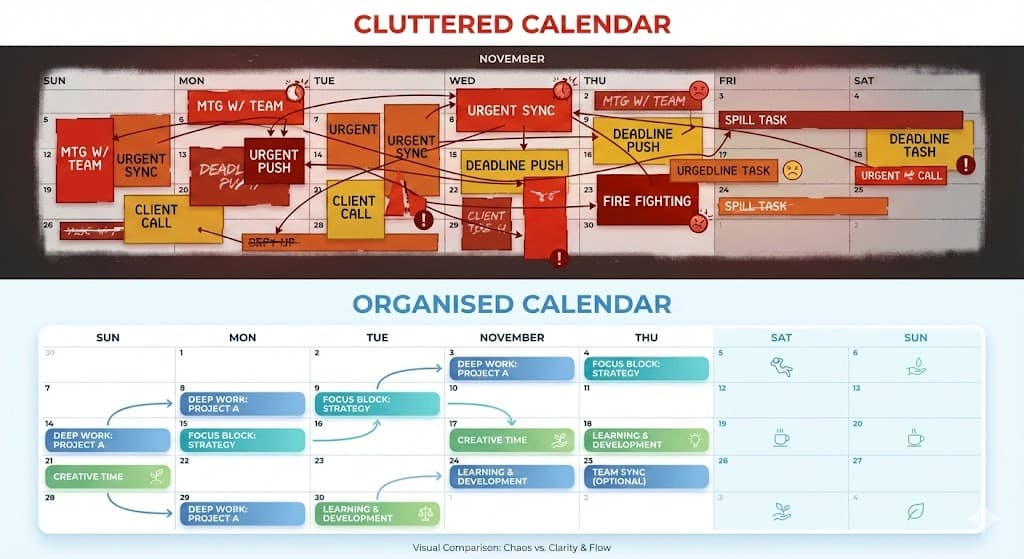 Calendar Comparison
When Meetings Still Make Sense
I'm not suggesting we abolish meetings entirely. That would be absurd. Some things genuinely benefit from real-time conversation.
Focused sessions with few participants. A meeting with three people who all need to be there, with a clear agenda and defined outcomes, can be incredibly productive. A meeting with fifteen people where twelve are just "keeping informed"? That's a broadcast, not a collaboration.
Connection and relationship building. For remote workers especially, the human element matters. Social activities, team bonding, casual conversation. These don't happen naturally when everyone's async. Schedule time for connection, but be intentional about it.
Collaborative work. Pair programming. Design reviews. Brainstorming sessions where you're actively building something together. These benefit from real-time interaction.
Difficult conversations. Some things shouldn't be written down. Performance discussions, sensitive feedback, complex negotiations. These deserve the nuance that comes with voice and presence.
The key is making synchronous time the exception rather than the default. In a work environment where asynchronous communication is the norm, any synchronous meetings that do take place tend to be more focused and productive.
The Real Ask
What I'm asking for isn't radical. It's this: before you send that calendar invite, pause and ask yourself a simple question.
Could this be an email? A Slack message? A shared document with comments?
If yes, do that instead. Your colleagues will thank you. Their productivity will thank you. Their ability to pick up their kids from school without guilt will thank you.
It's remarkable how people perform when their needs are being attended to a little bit better.
The meeting-industrial complex isn't going to dismantle itself. But we can all start making different choices, one calendar invite at a time.
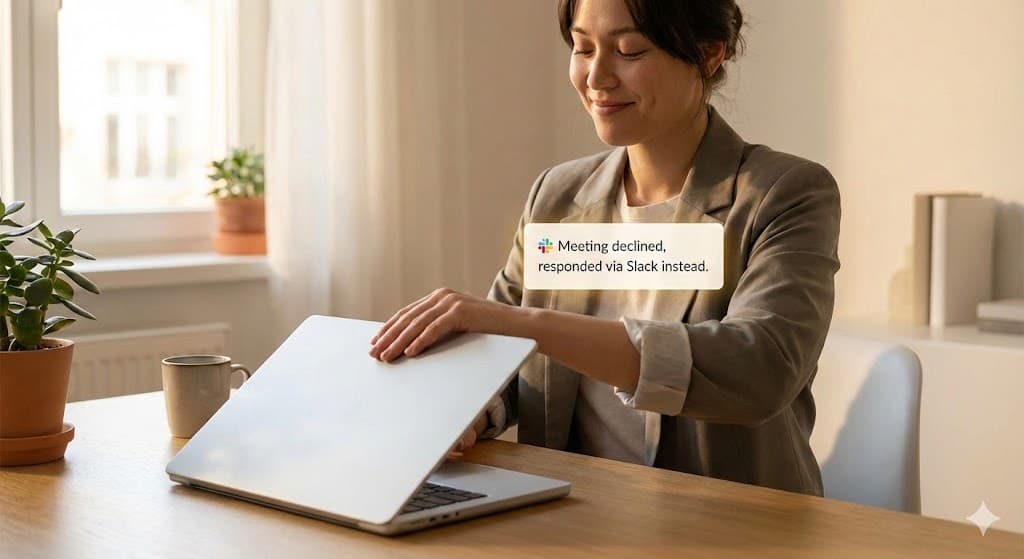 Async Success